MCT8 deficiency
Understanding MCT8 Deficiency
Thyroid hormones are essential for the development and functioning of nearly all tissues. Triiodothyronine, or T3, is the predominant bioactive thyroid hormone and must enter cells to exert its biological effects.
MCT8 is a cell-surface thyroid hormone transporter encoded by the SLC16A2 gene. It plays an important role in transporting thyroid hormones into and out of cells and is the predominant thyroid hormone transporter in the endothelial cells of the blood-brain barrier and in different types of neural cells.
In MCT8 deficiency, pathogenic variants in the SLC16A2 gene impair thyroid hormone transport. This results in a complex clinical presentation characterized by insufficient thyroid hormone activity in the central nervous system and persistently elevated circulating T3 in peripheral tissues.
The neurological and systemic manifestations together contribute to the substantial disease burden experienced by patients and their families.
A Neurodevelopmental and Multi-organ Disease
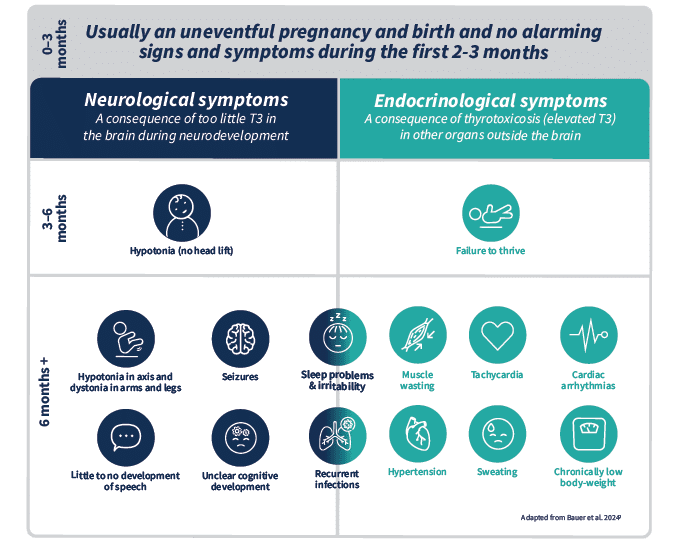
Patients with MCT8 deficiency present with a broad spectrum of symptoms resulting from disrupted or dysfunctional MCT8-mediated thyroid hormone transport in different tissues.
Common early clinical features include:
- Neurodevelopmental impairment
- Hypotonia and poor head control
- Failure to thrive or growth faltering
- Feeding difficulties
- Delayed gross and fine motor development
Over time, patients may experience:
- Severe intellectual and motor disability
- Movement disorders, including dystonia
- Muscle wasting and low body weight for age
- Impaired speech development
- Sleep disturbances
- Seizures
- Recurrent infections
- Cardiovascular complications, including tachycardia, arrhythmias and hypertension
The severity and presentation of individual symptoms can differ between patients. Proactive, optimized multidisciplinary care is essential throughout the patient’s life.
The Impact of Peripheral Thyrotoxicosis
MCT8 deficiency is associated with a pathognomonic thyroid hormone profile that includes elevated serum T3, low or low-normal T4, and normal to slightly elevated thyroid-stimulating hormone.
Persistently elevated circulating T3 contributes to a thyrotoxic state in peripheral tissues. The symptoms and long-term consequences of peripheral thyrotoxicosis contribute significantly to the overall burden of MCT8 deficiency.
Peripheral thyrotoxicosis may affect multiple organ systems and contribute to:
- A hypermetabolic state
- Failure to thrive and low body weight for age
- Muscle wasting
- Cardiovascular strain
- Gastrointestinal complications
- Changes in liver and bone markers
- Sleep disturbances
- Increased morbidity and premature mortality
When combined with severe neurodevelopmental impairment, these systemic effects result in a complex clinical presentation requiring coordinated multidisciplinary management.
When to Suspect MCT8 Deficiency
The early symptoms of MCT8 deficiency can be nonspecific. Low awareness of the condition and its characteristic clinical and biochemical presentation can result in diagnostic delay.
MCT8 deficiency should be considered in children presenting with features such as:
- Global developmental delay
- Hypotonia or poor head control
- Failure to thrive or low body weight for age
- Muscle wasting
- Feeding difficulties
- Tachycardia or other cardiovascular abnormalities
- Irritability
- Increased perspiration
- Sleep difficulties
- Movement disorders
- Seizures
- Recurrent infections
Symptoms may begin to emerge in the first months of life. MCT8 deficiency may initially be considered alongside other neurological, metabolic or genetic disorders with overlapping clinical features.
Diagnosing MCT8 Deficiency
Diagnosis of MCT8 deficiency is based on clinical signs and symptoms, a characteristic pattern of thyroid hormone levels in the blood, and confirmation through identification of a pathogenic variant in the SLC16A2 gene.
Characteristic thyroid hormone profile
The characteristic biochemical profile includes:
- Elevated serum T3
- Low or low-normal T4
- Normal to slightly elevated TSH
T3 is not routinely included in all standard thyroid hormone laboratory panels. When MCT8 deficiency is suspected, clinicians should consider specifically requesting measurement of serum T3 alongside other relevant thyroid hormone parameters.
Genetic confirmation
Identification of a pathogenic variant in the SLC16A2 gene confirms the diagnosis. Genetic testing should be considered when the clinical presentation and thyroid hormone profile indicate possible MCT8 deficiency, or when there is a positive family history.
Recognizing the characteristic thyroid hormone pattern, together with genetic testing, is essential for the diagnosis of MCT8 deficiency.
Multidisciplinary Management
MCT8 deficiency is a complex, lifelong condition requiring coordinated care from multiple medical and allied healthcare disciplines.
Depending on the patient’s individual needs, the multidisciplinary team may include:
- Pediatric or adult endocrinologists
- Neurologists
- Geneticists
- Cardiologists
- Dietitians
- Gastroenterologists
- Physiotherapists
- Occupational therapists
- Speech and language therapists
- Rehabilitation specialists
- Orthopedic specialists
- Specialized nursing and daycare services
Patient needs change throughout childhood and adulthood. Regular evaluation of nutritional status, body weight, feeding, mobility, cardiovascular health and other disease manifestations can help guide individualized care.
Epidemiology
Epidemiologic data for MCT8 deficiency are limited but suggest an overall population prevalence of fewer than 1 to 3 per million.
As awareness, biochemical testing and access to genetic testing improve, more patients may receive an accurate diagnosis.


EMCITATE® (tiratricol)
EMCITATE® (tiratricol) is indicated for the treatment of peripheral thyrotoxicosis in adults and pediatric patients with MCT8 deficiency In the European Union EMCITATE® (tiratricol) is approved for the treatment of peripheral thyrotoxicosis in patients with monocarboxylate transporter 8 deficiency, from birth.
Explore